

UK Gamers FURIOUS as PlayStation Demands Biometrics to Play Online
The UK Online Safety Act is making PS5 nearly unusable for thousands — and US lawmakers are already copying the playbook.

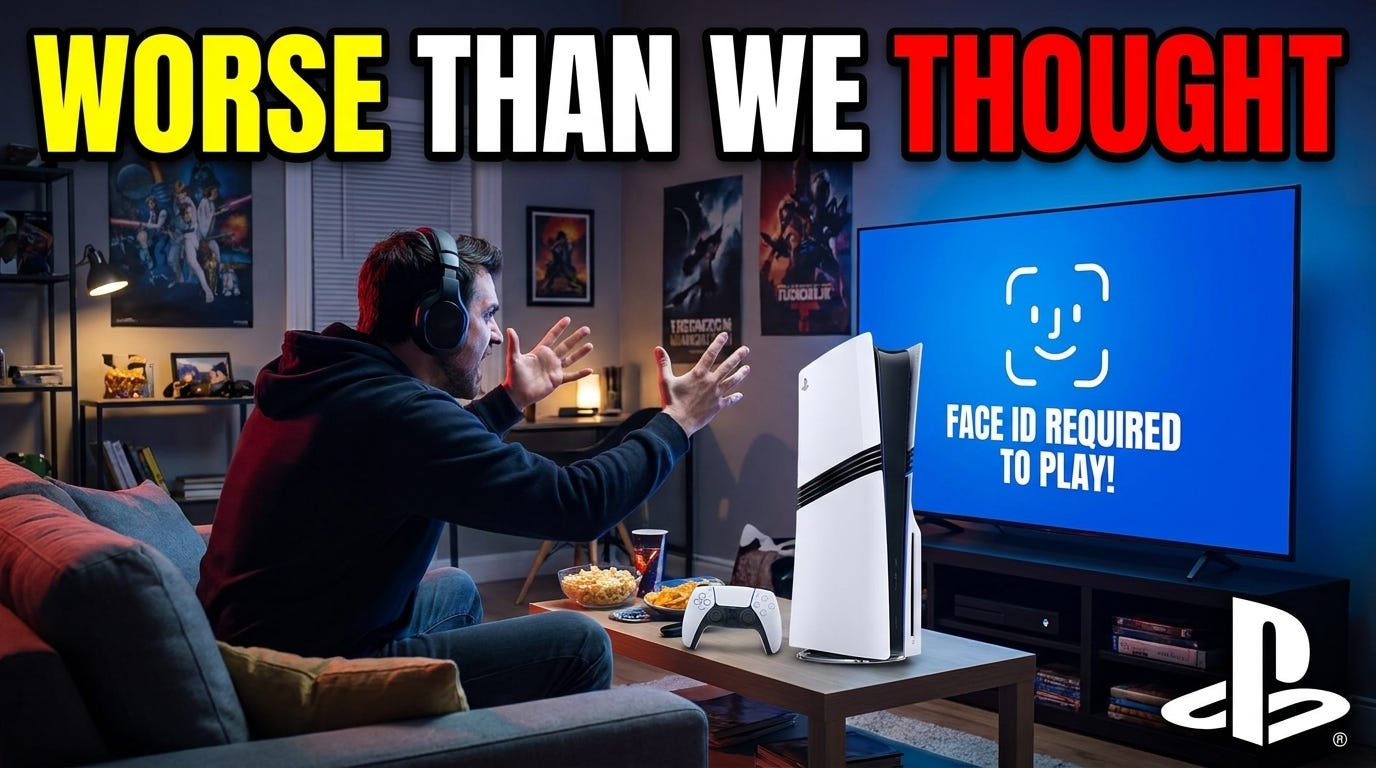
🔥 Sony is requiring UK PlayStation users to submit a face scan, government ID, or phone number just to use basic online features — or lose them entirely.
🧠 This is Sony’s compliance with the UK’s Online Safety Act, which mandates age verification for social features on all platforms — going fully mandatory in June 2026.
📺 Voice chat, text messaging, parties, game broadcasting, and user-generated content sharing are all locked behind the new age gate.
🎮 The third-party verification company Sony chose — Yoti — was fined nearly €1 million by Spain for storing biometric data longer than it promised.
💸 Games, trophies, and the PlayStation Store still work — but for millions of UK players, their console just got a lot less useful.
The UK gaming community is in an uproar. Overnight, Sony transformed PlayStation from a gaming console into what many users are calling a surveillance checkpoint — and they want to talk about it.
What’s Actually Happening in the UK
The UK’s Online Safety Act (OSA) is a sweeping piece of legislation designed to protect minors online. One of its requirements: platforms must verify users’ ages before allowing access to social or communication features. Gaming platforms — including PlayStation — are not exempt.
Sony’s answer is a partnership with Yoti, a UK-based age verification company. To keep access to voice chat, parties, messaging, and broadcasting features, UK PlayStation users must do one of three things:
Submit a face scan to Yoti’s AI system
Upload a government-issued ID
Verify via a mobile phone number
Here’s where it gets worse. Millions of UK users on Pay-As-You-Go (PAYG) mobile plans can’t use the phone option — it requires a contract number. That leaves face scans or government ID as their only choices. Many are simply refusing.
And Yoti isn’t exactly inspiring confidence. Spain’s data protection authority (AEPD) fined Yoti €950,000 in early 2026 after finding the company stored facial scan images longer than legally allowed and failed to obtain proper consent for processing biometric data. That’s the company Sony is asking millions of gamers to hand their faces to.
The features going behind the wall in June 2026: voice chat, text chat, party creation, group membership, live broadcasting to YouTube or Twitch, and sharing user-generated content. Your games still work. Your trophies still exist. But the social layer that makes online gaming online gaming? That’s now gated by a biometric checkpoint.
The Gaming Community Reacts
The backlash has been massive. This tweet from @Pirat_Nation pulled over 729,000 impressions in under 24 hours:


The replies are split between fury at Sony, fury at the UK government, and people genuinely confused about why this is a problem. That last group is part of what makes this so maddening to the gamers who do care.
@Dr_Rebecca put it plainly — her post hit 3.8 million impressions:


And @KaiKai2492 said what a lot of people were thinking:


The sentiment in the replies spans the full spectrum: some are suggesting VPNs as workarounds (Sony is blocking them), some are saying they’re sticking with their PS4 forever, and others are just accepting it — which might be the most chilling outcome of all.
Could This Hit the USA Next?
Short answer: yes, and it’s already in motion.
The Kids Online Safety Act (KOSA) was reintroduced in the 119th Congress in 2025 and advanced through committee in March 2026. While the current version of KOSA stops short of mandating platform-level age verification, the KIDS Act — a companion bill — would require it for mature content access on gaming platforms, social media, and streaming services.
Four US states have already passed age verification laws: Utah, Louisiana, Texas, and Alabama. Each law is slightly different, creating a compliance nightmare that’s likely to push federal legislators toward a unified national standard.
Sound familiar? That’s exactly how the UK’s Online Safety Act came together.
The difference is that the US has stronger First Amendment protections and a more skeptical tech lobby. But if KOSA or the KIDS Act passes in its stronger form, American PS5 owners could be staring down the same Yoti prompt that’s infuriating UK gamers right now. The UK is the test case. The US is watching.
What You Should Do Right Now
If you’re a UK gamer: Know what’s changing in June 2026. Games and purchases aren’t affected, but your ability to party up, voice chat, or stream could be. Decide now whether you’re complying — or looking at alternatives.
If you’re a US gamer: Pay attention. Contact your representatives about KOSA and the KIDS Act. The debate over how to protect kids online is legitimate — the debate over whether biometrics and government IDs are the right tool is also legitimate, and gamers should be part of it.
Regardless of where you live: The broader question here isn’t PlayStation-specific. This is about whether the price of online access is your face, your ID, and your privacy. That’s a conversation worth having before it’s mandatory.
Image credits: Sony PlayStation / PixelBuys
Sources
TechRadar — PlayStation age verification rolls out in UK and Ireland
Sports Keeda — Why PlayStation UK age verification triggered massive backlash
Davis Wright Tremaine — Federal Online Safety Legislation Hits Congress 2026
Fortune — Social media companies scramble to verify minors, Congress complicates it
Roll Call — Kids online safety bills advance from Senate, House panel